RAG & AI Agents
Retrieval-Augmented Generation and AI Agents: The Architecture Behind Production LLM Systems Two problems separate a demo from a production LLM system. The first: a model only…
2
Technologies
0
Services
Retrieval-Augmented Generation and AI Agents: The Architecture Behind Production LLM Systems
Two problems separate a demo from a production LLM system. The first: a model only knows what it was trained on, so it's blind to your documents, your database, anything that changed after its training cutoff. The second: a model can only talk — it can't look anything up, call an API, or take a multi-step action on its own. Retrieval-Augmented Generation (RAG) solves the first problem. AI agents solve the second. Together, they're the architecture underneath nearly every serious enterprise LLM deployment shipping today.
How Retrieval-Augmented Generation actually works
A production RAG pipeline has more moving parts than "search, then paste into the prompt." Documents are first split into chunks — small enough to retrieve precisely, large enough to preserve context. Each chunk is converted into an embedding, a numerical vector representing its meaning, and stored in a vector database. At query time, the user's question is embedded the same way, and the system searches for the chunks whose vectors are closest to it. Those candidates are typically passed through a reranker — a smaller, more precise model that reorders results by actual relevance, since vector similarity alone is a blunt instrument. The top-ranked chunks are injected into the prompt as context, and only then does the LLM generate an answer.
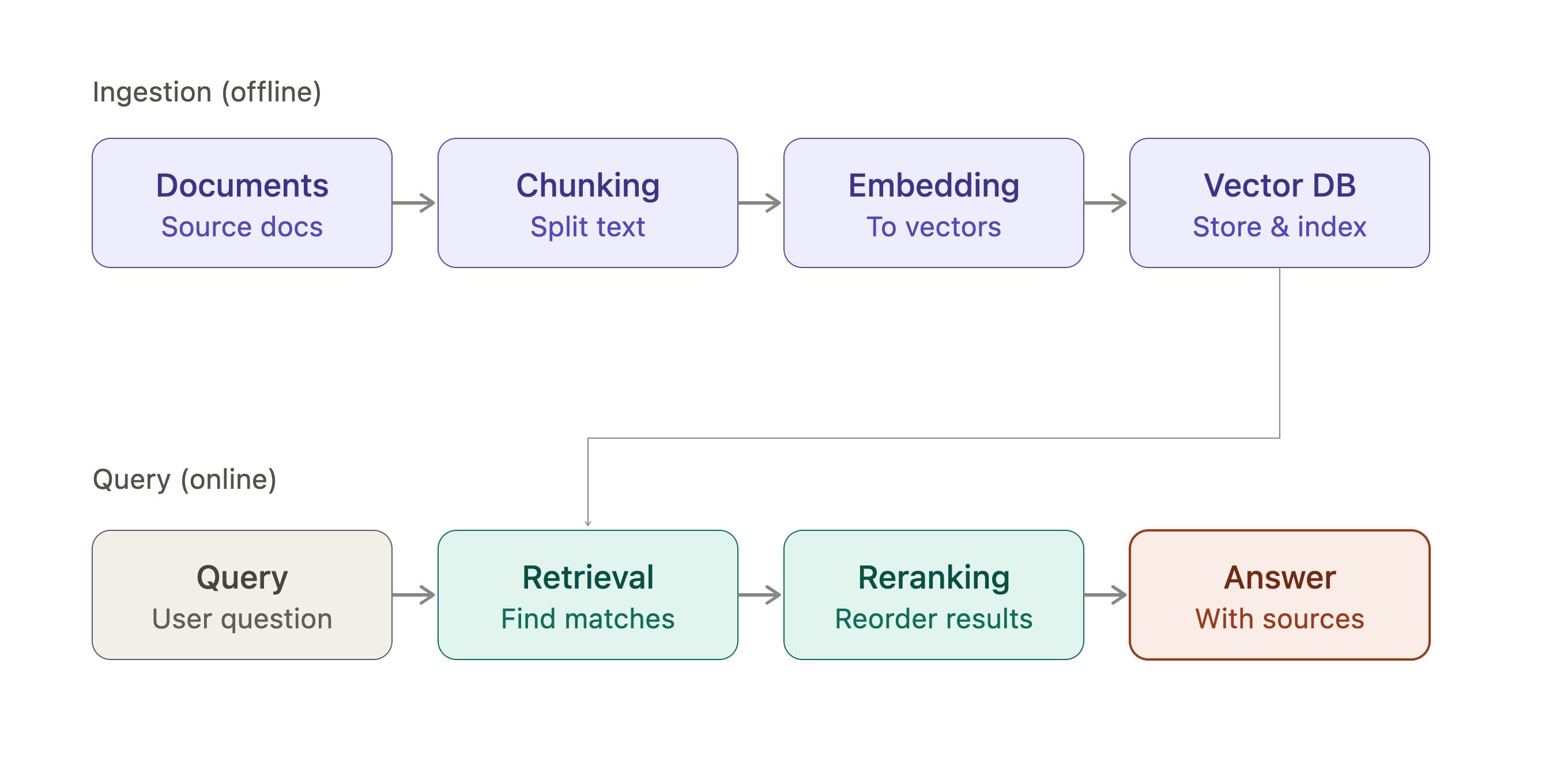
Diagram to source: a left-to-right pipeline graphic (Documents → Chunking → Embedding → Vector DB → Retrieval → Reranking → LLM → Answer). Commission an original or license one — the well-known versions circulating online (ResearchGate figures, vendor blog diagrams) are copyrighted to their publishers and shouldn't be hotlinked or reproduced. Re-host the final asset through your own media library.
| Chunking strategy | Context preservation | Retrieval precision | Best for |
|---|---|---|---|
| Fixed-size | Low — can split mid-thought | Fast, simple, less precise | Homogeneous, short-form content |
| Recursive (structure-aware) | Medium — respects paragraphs/sections | Balanced | General-purpose enterprise docs |
| Semantic | High — splits at meaning boundaries | Slower to compute, most precise | Dense technical or legal content |
Scroll to see more →
RAG vs. fine-tuning vs. long-context prompting
This is usually the first architectural decision, and it's often made incorrectly by defaulting to whichever approach a team already knows.
| Approach | Data freshness | Cost profile | Latency | When it wins |
|---|---|---|---|---|
| RAG | Real-time — re-index and it's current | Retrieval + storage infra, no retraining | Retrieval adds a hop, but predictable | Frequently changing knowledge, need for citations |
| Fine-tuning | Frozen at training time | High upfront, cheap per-query after | Fast — no retrieval step | Stable domain knowledge, style/format adaptation |
| Long-context prompting | As current as what you paste in | High per-query token cost at scale | Degrades as context grows | Small, bounded document sets; prototyping |
Scroll to see more →
From retrieval to action: what makes something an agent
RAG makes a model better informed. It doesn't make a model capable of doing anything with that information beyond answering. An agent adds a loop around the model: it plans a sequence of steps, calls tools (a RAG retriever is often just one of those tools, alongside APIs, code execution, or database writes), observes what came back, and decides whether to continue, retry, or stop.
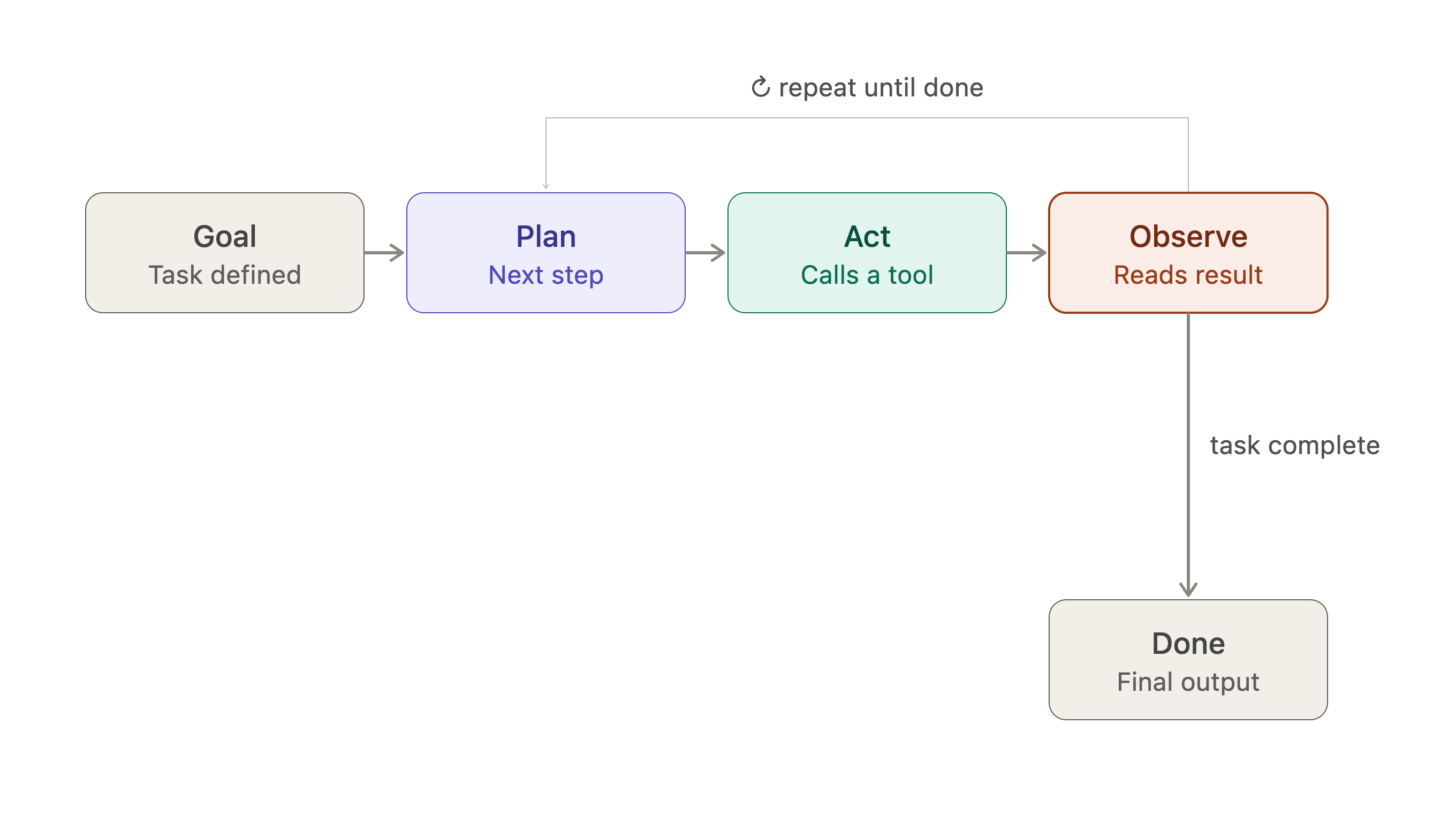
Diagram to source: a circular/looping diagram (Plan → Act (tool call) → Observe → Decide → back to Plan), with a small branch showing RAG retrieval as one tool among several (also: code execution, external APIs, database writes). Original commission recommended — this is specific enough to your architecture that a generic stock diagram likely won't match.
Multi-step task decomposition — breaking a vague goal into an ordered sequence of concrete actions.
Tool and API invocation — calling out to real systems, not just describing what it would do.
Memory across turns — carrying state through a multi-step task instead of treating each step as isolated.
Self-correction — noticing a tool call failed or returned something unexpected, and adjusting the plan rather than pressing forward blindly.
Agent architectures compared
| Architecture | Complexity | Reliability | Typical use case |
|---|---|---|---|
| Single agent | Low | High for narrow, well-scoped tasks | A defined workflow with a small tool set |
| Orchestrator / multi-agent | High | Depends heavily on coordination design | Complex tasks split across specialized sub-agents |
| Human-in-the-loop | Medium | Highest — a person approves high-stakes steps | Irreversible actions: payments, deployments, external comms |
Scroll to see more →
What enterprise-grade RAG and agents actually require
Data governance per retrieval — access control enforced at the retrieval layer, so a user only ever retrieves chunks they're already authorized to see.
Latency at scale — retrieval and reranking add real time; production systems need this budgeted and monitored, not discovered after launch.
Versioned knowledge bases — so a retrieval result can be traced to exactly which version of a document it came from.
Audit logging — every retrieval and every tool call an agent makes, logged and reviewable, not just the final answer.
Where Automex fits in
Automex handles both layers as one system instead of two integration projects. The retrieval pipeline — chunking, embedding, vector storage, reranking — runs with access control enforced at query time, not bolted on afterward. Agent orchestration sits on top, with RAG available as a built-in tool alongside your own APIs, scoped permissions per agent, and full step-by-step logging.
One platform, not two integrations — RAG and agent orchestration share the same infrastructure, monitoring, and access model.
Governance built in — retrieval respects existing permissions; every agent action is logged and reviewable.
Production latency budgets — retrieval and reranking tuned for live request paths, not batch-only workloads.
Evaluating RAG or agents for a production workload? Talk to us about an architecture review.
Technologies
(2)Interested in RAG & AI Agents?
Let's discuss how this AI capability can address your specific business needs.