Business Process Automation
Business Process Automation: Rules-Based Bots vs. AI Agents "Automation" now covers two genuinely different tools, and picking the wrong one is the most common way an automation…
2
Technologies
0
Services
Business Process Automation: Rules-Based Bots vs. AI Agents
"Automation" now covers two genuinely different tools, and picking the wrong one is the most common way an automation project stalls. RPA (robotic process automation) follows an exact set of steps, every time, with no variation. AI agents handle processes that need judgment — reading a message, deciding what it means, choosing what to do next. Most real workflows need both, applied to the right parts.
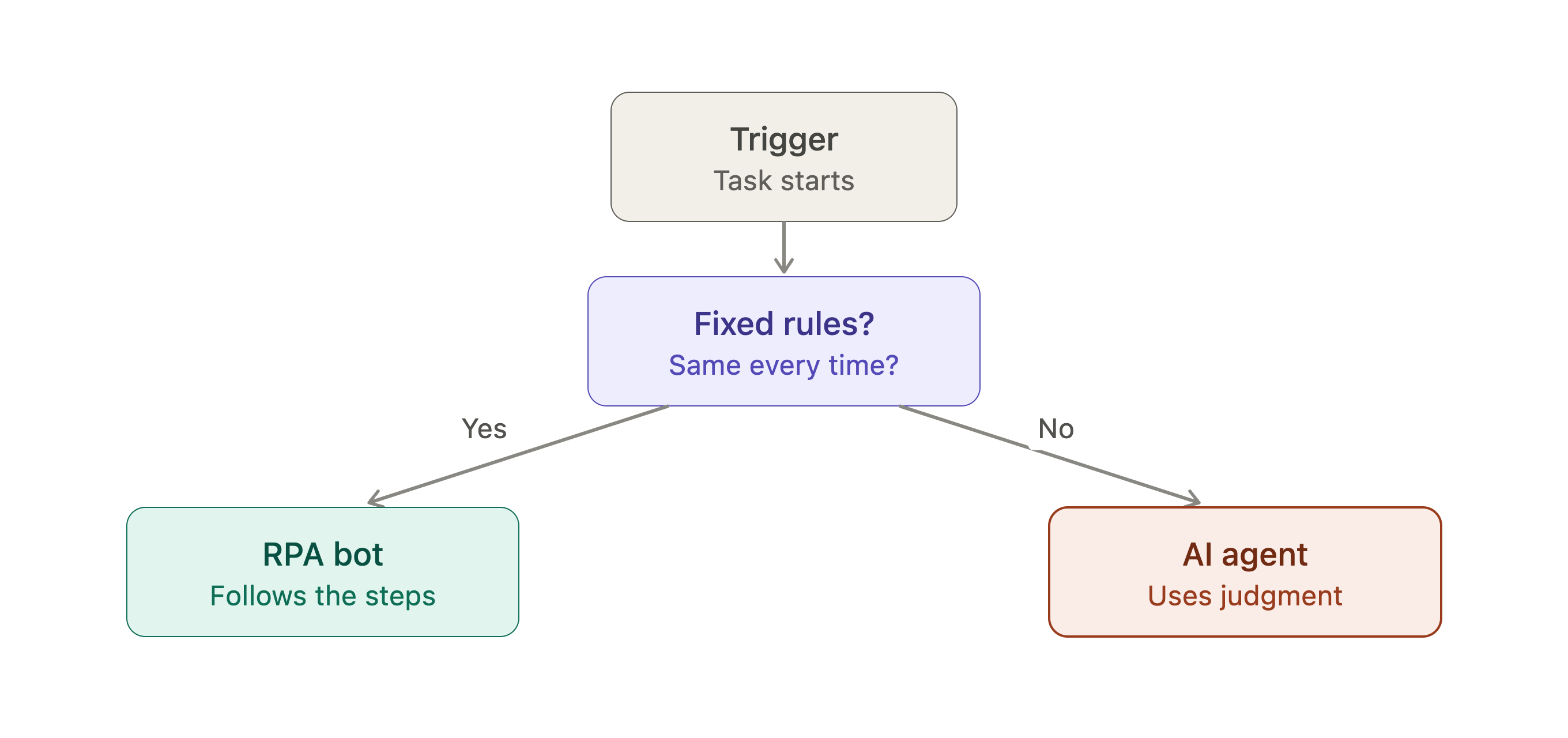
Diagram to source: a simple decision flow (Trigger → "Fixed rules?" → RPA bot / AI agent). A live reference version was rendered during planning — use it as the design spec, then host the final asset through your own media library.
| RPA | AI agent | |
|---|---|---|
| Handles | Fixed, repetitive steps | Tasks needing judgment or context |
| Setup cost | Lower, faster to deploy | Higher upfront, more flexible after |
| When the process changes | Bot breaks, needs rebuilding | Adapts without a rebuild |
| Best for | Data entry, form filling, copying between systems | Triage, routing, exceptions, anything with "it depends" |
Scroll to see more →
Where each one actually shows up
Invoice processing — RPA extracts and enters standard fields; an agent handles the invoice that doesn't match the expected format.
Customer request routing — an agent reads the request and decides which team should handle it, something a fixed rule can't reliably do.
Approvals — RPA moves a request through a known chain; an agent flags the one that needs a human to look twice.
Data entry between systems — the textbook RPA case: same fields, same format, every time.
Where Automex fits in
Automex handles both sides of this without forcing a choice upfront — rules-based steps run as straightforward automation, and the parts of a workflow that need judgment route to an AI agent, in the same process, on the same platform.
Start where it's obvious — automate the fixed steps first, add agent handling for exceptions as they show up.
Nothing silently breaks — monitoring flags a process the moment its rules stop matching reality, instead of it failing quietly.
Have a process in mind? Talk to us about what to automate first.
Technologies
(2)Interested in Business Process Automation?
Let's discuss how this AI capability can address your specific business needs.