Automex LogoAutomex Logo
Home

Services

End-to-end digital solutions

View All Services

AI & Automation

  • AI Agents & Chatbots
  • Business Process Automation

Digital Transformation

Modernize your business with our end-to-end digital transformation services.

Learn More

Solutions

Cutting-edge AI and software solutions that automate, scale, and transform your business operations.

View All Solutions
  • Natural Language Processing
  • Computer Vision
  • Predictive Analytics
  • Business Process Automation
  • Generative AI Applications
  • AI Model Operations (MLOps)
  • RAG & AI Agents

Industries

Industry-specific solutions tailored to the unique challenges and regulations of your sector.

View All Industries
  • Healthcare
  • Financial Services
  • Manufacturing
  • Education
  • Government & Public Sector
  • Logistics & Supply Chain
  • Retail & E-Commerce
  • Real Estate
  • Technology & SaaS
  • Energy & Utilities

Expertise

Deep technical expertise across the full technology stack.

View All Expertise
  • AI Agents & Intelligent Automation
  • Generative AI Solutions
  • Enterprise Software Architecture
  • Cloud-Native Architecture
  • Data Engineering & Analytics
  • Mobile Application Development
  • Cloud Infrastructure & Solutions
  • Cybersecurity & Compliance
  • Quality Engineering & Testing
  • DevOps & Continuous Delivery

Portfolio

Explore our work

View All Projects
  • Building a Modern Digital Platform for Global Trade & Sourcing

Case Studies

Real-world success stories see how we've delivered results for clients across industries.

View All Case Studies
  • Building a Modern Digital Platform for Global Trade & Sourcing

Tech Partners

Technology and implementation partners we collaborate with to deliver end-to-end solutions.

View All Tech Partners
  • OpenAI
  • Microsoft Azure
  • Amazon Web Services (AWS)
  • Google Cloud
  • Anthropic Claude
  • Prisma
  • Docker
  • Hostinger
  • Meta WhatsApp Business Platform

Blog

Latest insights and updates

View All Blog Posts
  • Blog
  • About Us
  • Contact
  • FAQs
  • CRM Overview
  • Book a Call
  • Request a Quote
  • Contact Sales
Menu
Home
AI Agents & ChatbotsBusiness Process Automation
Natural Language ProcessingComputer VisionPredictive AnalyticsBusiness Process AutomationGenerative AI ApplicationsAI Model Operations (MLOps)RAG & AI Agents
HealthcareFinancial ServicesManufacturingEducationGovernment & Public SectorLogistics & Supply ChainRetail & E-CommerceReal EstateTechnology & SaaSEnergy & Utilities
AI Agents & Intelligent AutomationGenerative AI SolutionsEnterprise Software ArchitectureCloud-Native ArchitectureData Engineering & AnalyticsMobile Application DevelopmentCloud Infrastructure & SolutionsCybersecurity & ComplianceQuality Engineering & TestingDevOps & Continuous Delivery
Building a Modern Digital Platform for Global Trade & Sourcing
OpenAIMicrosoft AzureAmazon Web Services (AWS)Google CloudAnthropic ClaudePrismaDockerHostingerMeta WhatsApp Business Platform
Blog
About UsContactFAQs
CRM OverviewBook a CallRequest a QuoteContact Sales
Back to AI Capabilities

Computer Vision

Computer Vision: Architecture, Trade-offs, and What Production Actually Requires "Computer vision" isn't one capability — it's a family of distinct tasks that happen to…

Computer VisionExperimentalActive
Request a Quote
Computer Vision Thumbnail Image

1

Technologies

0

Services

Computer Vision: Architecture, Trade-offs, and What Production Actually Requires

"Computer vision" isn't one capability — it's a family of distinct tasks that happen to share an input format. Classification answers "what's in this image." Object detection answers "where is it." Segmentation answers "which exact pixels belong to it." OCR answers "what text does it contain." Treating these as interchangeable is where a lot of vision projects go wrong before they even start.

Working definitions: every vision task shares the same underlying pipeline — an image gets preprocessed, passed through a backbone model that extracts features, then a task-specific head turns those features into a classification label, a bounding box, a pixel mask, or extracted text.

The core vision pipeline

A raw image is just a grid of pixel values — nothing a model can reason about directly. Preprocessing resizes and normalizes it into a consistent format. A backbone — historically a convolutional neural network (CNN), increasingly a vision transformer (ViT) — extracts a hierarchy of features: edges and textures in early layers, shapes and object parts in deeper ones. A task head sits on top of those features and produces whatever the task needs. The same backbone can often feed multiple heads — one model, several outputs.
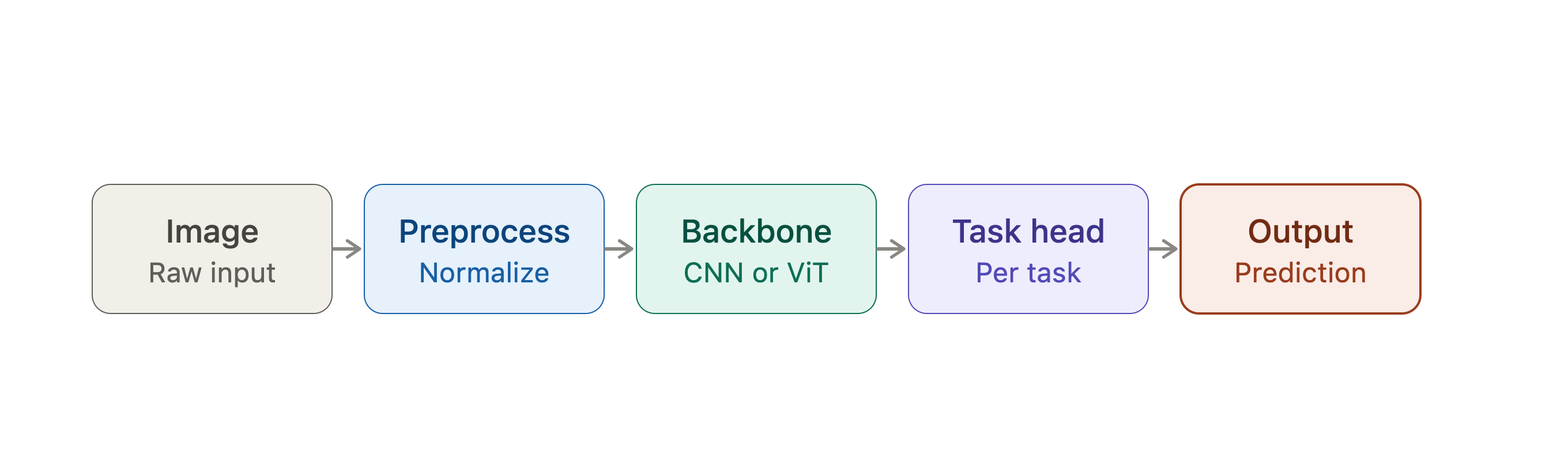
Computer vision pipeline diagram: image through preprocessing, backbone, task head, to prediction output
The shared pipeline every vision task runs through, before the task head specializes the output.

Diagram to source: a 5-stage left-to-right pipeline (Image → Preprocess → Backbone → Task head → Output). A live reference version of this diagram was rendered during planning — use it as the design spec for a commissioned or licensed final asset, then host it through your own media library.

Where vision models actually fail in production: lighting and domain shift — a model trained on daytime warehouse footage degrades on low-light or a different camera angle it never saw in training. Adversarial and edge-case inputs it wasn't prepared for. Resolution limits that quietly drop small objects. Class imbalance that makes rare-but-critical categories (a defect, a restricted item) the ones the model is worst at, precisely because they were underrepresented in training data.

The four core tasks, compared

TaskOutputTypical latencyTypical use case
ClassificationA label for the whole imageFastestContent moderation, quality pass/fail
Object detectionBounding boxes + labelsFastCounting, tracking, shelf/inventory monitoring
SegmentationPixel-level mask per objectSlower — dense predictionMedical imaging, precise defect boundaries
OCRExtracted text + locationVaries with document complexityDocument processing, invoice/form extraction

Scroll to see more →

What's in this image — classification, the coarsest and fastest signal.

Where it is — detection, a box and a label per object instance.

The exact pixel boundary — segmentation, when a bounding box isn't precise enough.

What text it contains — OCR, turning an image of text into structured, searchable data.

CNNs vs. vision transformers

A convolution kernel looks at a small local window of the image and slides across it — it builds understanding of the whole image gradually, layer by layer, from local patterns upward. A vision transformer instead splits the image into patches and lets every patch attend to every other patch directly, from the first layer — global context immediately, at the cost of needing far more training data to learn what a convolution gets for free as a built-in assumption.
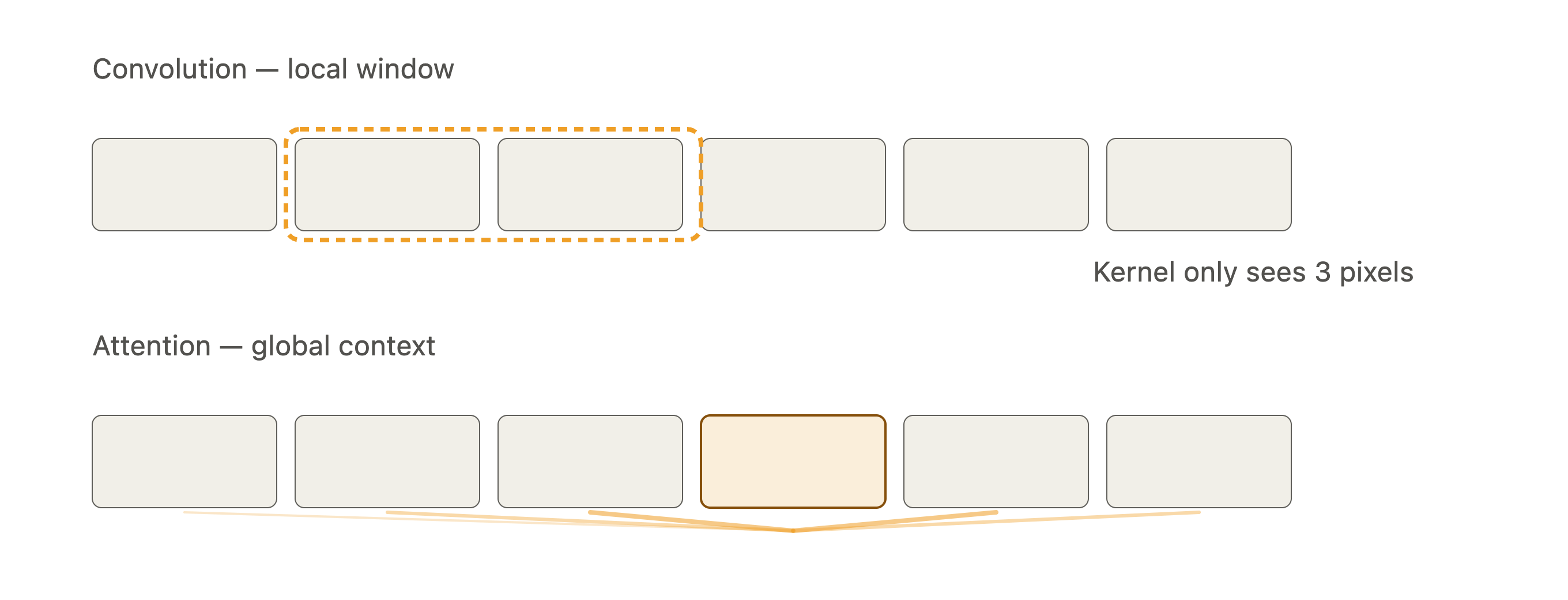
Diagram contrasting a CNN's local convolution window with a vision transformer's global attention across image patches
Local receptive field (CNN) versus global attention (ViT) — the core architectural difference.

Diagram to source: side-by-side or stacked comparison — a small sliding kernel window over a few grid cells (CNN), and one patch fanning attention lines out to every other patch (ViT). A live reference version was rendered during planning; use it as the design spec.

ArchitectureData efficiencyCompute costWhen it wins
CNNHigh — works well on smaller datasetsLower, scales predictablyLimited labeled data, edge/on-device deployment
Vision transformerLow — needs large-scale pretrainingHigher, especially at high resolutionLarge datasets available, accuracy ceiling matters most

Scroll to see more →

What enterprise-grade computer vision actually requires

Data privacy by design — sensitive imagery (medical, biometric, surveillance) often needs on-device or private-cloud inference, not a third-party API call per frame.

Real-time latency for video — streaming and live camera feeds need per-frame inference budgets, not batch-job latency.

Versioned model rollouts — so a regression in accuracy on a specific camera or site can be traced to exactly which model version was live.

Bias and fairness evaluation — accuracy tested across demographics, lighting conditions, and camera hardware, not just an aggregate benchmark score.

Vision models fail silently and confidently. An out-of-distribution input rarely produces an obviously wrong-looking output — it produces a confident, plausible-looking wrong one. Production systems need calibrated confidence thresholds and a human review path for low-confidence or high-stakes predictions, not just a raw accuracy number from a validation set that may not reflect real deployment conditions.

Where Automex fits in

Automex handles the full vision pipeline — ingestion, preprocessing, inference, and post-processing — as one managed system, with the production requirements above built in rather than added after an incident. Classification, detection, segmentation, and OCR share the same infrastructure, monitoring, and confidence-threshold tooling.

One pipeline, every task — classification, detection, segmentation, and OCR without separate integrations for each.

Deployment flexibility — on-device, private cloud, or managed inference depending on data sensitivity.

Built for streaming — latency budgets designed for live video, not just batch image processing.

Automex is already running vision inference in production for document processing, quality inspection, and monitoring workloads — with confidence thresholds and human review paths configured, not bolted on afterward.

Have a vision use case to evaluate? Talk to us about a pilot.

Technologies

(1)
OpenAI
Get Started

Interested in Computer Vision?

Let's discuss how this AI capability can address your specific business needs.

Request a Quote
Infinity Solutions logo

AUTOMEX

AI & Automation Solutions

Enterprise grade AI, cybersecurity, software engineering, cloud infrastructure, and digital transformation all under one roof.

Chat on WhatsAppSend an email
Remote-first team operating globally across the world.

Services

  • AI SolutionsPopular
  • AI Bots & Automation
  • Software Development
  • Web Development
  • Mobile App Development
  • Cybersecurity Services

Technology

  • Claude AI IntegrationNew
  • API Integration
  • Database Architecture
  • Cloud Infrastructure
  • Security ComplianceEnterprise
  • Digital Transformation

Company

  • About Us
  • Our Services
  • Blog & Insights
  • Case Studies
  • Contact Us
  • Privacy Policy
  • Terms of Service

Ready to transform your business?

Tell us about your project and we'll respond within 24 hours.

Get started

© 2026 automex. All rights reserved.

PrivacyTermsSitemap