Natural Language Processing
Natural Language Processing: How Machines Actually Understand Text Every time a chatbot answers a support ticket, a search bar returns the right result despite a typo, or an app…
3
Technologies
2
Services
Natural Language Processing: How Machines Actually Understand Text
Every time a chatbot answers a support ticket, a search bar returns the right result despite a typo, or an app auto-tags a review as "negative," there's a pipeline of Natural Language Processing (NLP) underneath it. NLP is the branch of AI focused on getting machines to read, interpret, and generate human language — and it's the layer that turns raw text into something a system can actually act on.
How an NLP pipeline actually works
Under the hood, most NLP systems break a piece of text down in stages. First, tokenization splits text into words or sub-word units. Next, those tokens are converted into embeddings — numerical vectors that capture meaning, so that "great" and "excellent" end up mathematically close together even though they're different words. From there, a model (increasingly, a transformer-based language model) processes those vectors in context to produce whatever the task needs: a classification label, an extracted entity, a summary, or a generated reply.
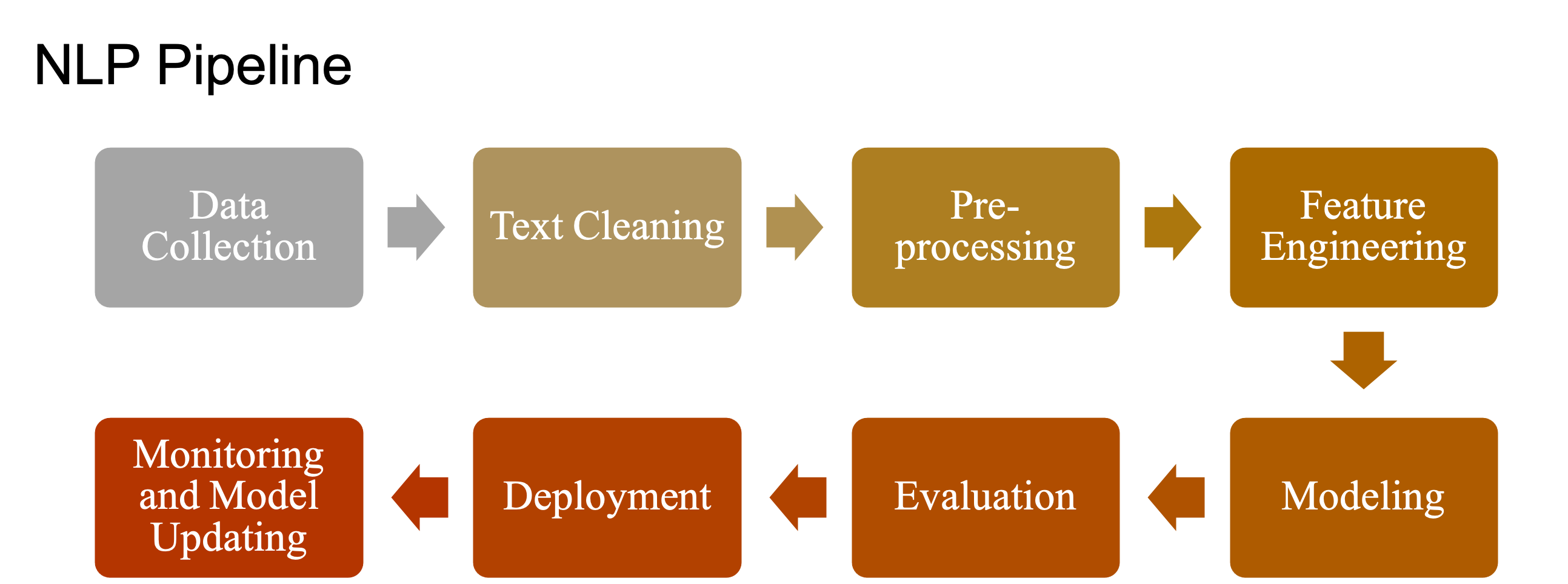
Diagram to source: a clean left-to-right pipeline graphic (Text → Tokenization → Embeddings → Model → Output). Search terms: "NLP pipeline architecture diagram." License and re-host through your own media library before publishing — don't hotlink a third-party URL in production.
From rule-based systems to transformers
NLP hasn't always worked this way. Early systems relied on hand-written grammar rules; later ones used statistical models trained on labelled examples. The current generation is built on transformer architectures — the same family of models behind large language models — which read an entire sentence (or document) at once and weigh how every word relates to every other word.
| Approach | Flexibility | Data needed | Typical use today |
|---|---|---|---|
| Rule-based | Low | None (hand-coded) | Narrow, deterministic tasks |
| Statistical / ML | Medium | Moderate, labelled | Legacy classifiers, spam filters |
| Transformer-based | High | Large pretraining + light fine-tuning | Most production NLP today |
Scroll to see more →
Diagram to source: the classic encoder/decoder transformer block diagram. A CC-BY-SA licensed version exists on Wikimedia Commons ("The-Transformer-model-architecture.png") — re-download and re-host it yourself with attribution rather than hotlinking, since Commons URLs aren't guaranteed stable for production embeds.
What this looks like in production
Sentiment & intent detection — classify incoming messages by tone or purpose before they hit a human queue.
Entity extraction — pull names, dates, amounts, and product references out of free text automatically.
Summarization — condense long documents or threads into a few sentences.
Semantic search — match queries to results by meaning, not just keyword overlap.
Where Automex fits in
This is exactly the layer Automex is built to handle. Instead of stitching together tokenizers, embedding models, and inference infrastructure yourself, Automex exposes NLP as a capability you call directly — classification, extraction, summarization, and search, all sharing the same pipeline and monitoring.
Deploy in minutes — point Automex at your text data and get structured output without training a model from scratch.
Built for production — consistent latency, versioned models, and clear fallback behavior instead of silent failures.
Fast enough for real workflows — low-latency inference designed to sit inline in live request paths, not just batch jobs.
Ready to see it on your own data? Talk to us about an NLP pilot.
Technologies
(3)Related Services
(2)AI Agents & Chatbots
Autonomous AI agents that handle customer support, sales, and lead generation across WhatsApp, Telegram, and your website working around the clock without adding headcount.
Business Process Automation
We map your CRM, ERP, and internal workflows, then build automation that removes manual busywork so your team stops copy-pasting data and starts running on autopilot.
Interested in Natural Language Processing?
Let's discuss how this AI capability can address your specific business needs.